0.6 Survival | Mapping Caldermuir & Hidden Supplies
Drawing a region, following a survivor’s lead, and finding the stories left behind.
A place on the map. A reason to leave the refuge.
Finishing Home left me with a question. If I wanted the refuge in Ashwick to feel like somewhere worth returning to, the world beyond its door needed to feel like a place too. A list of useful destinations could tell you where to find supplies. It could not quite explain where you were.
This part of 0.6 Survival has been about that missing sense of place: drawing Caldermuir, letting each survivor's knowledge bring it into focus, and putting a few more reasons to venture out along the way. It has taken more iterations than the finished screen might suggest.
The Caldermuir Atlas and Hidden Supplies are now available on Stable. This is a completed Survival milestone, rather than a claim that everything planned for 0.6 is finished.
A WORLD BETWEEN THE DESTINATIONS
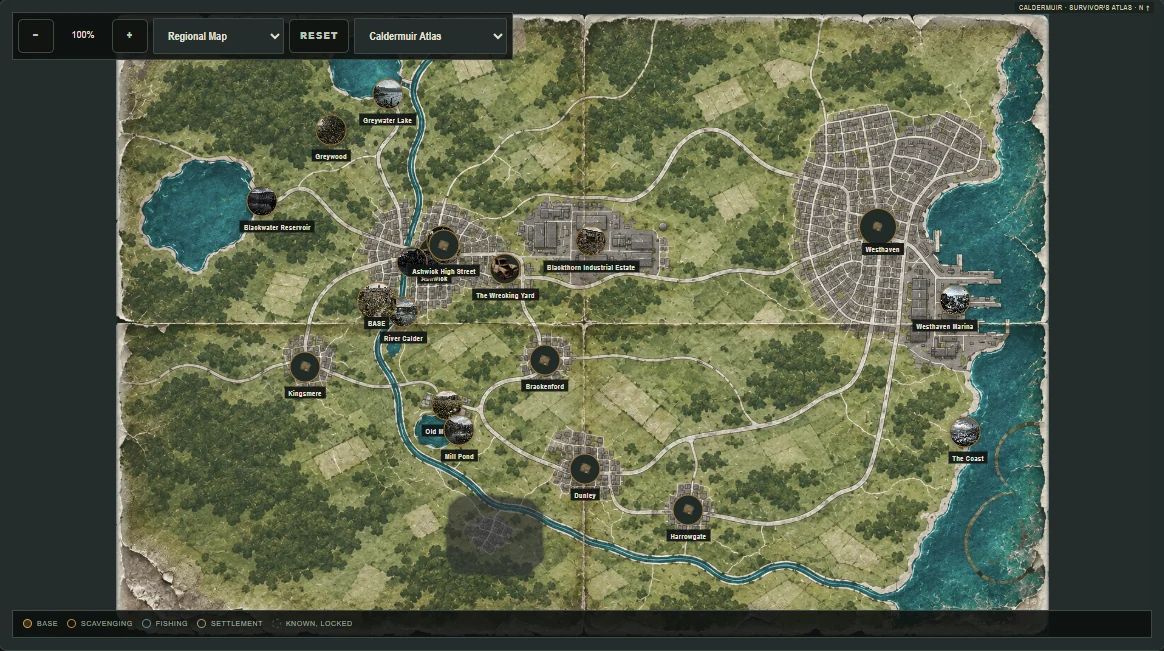
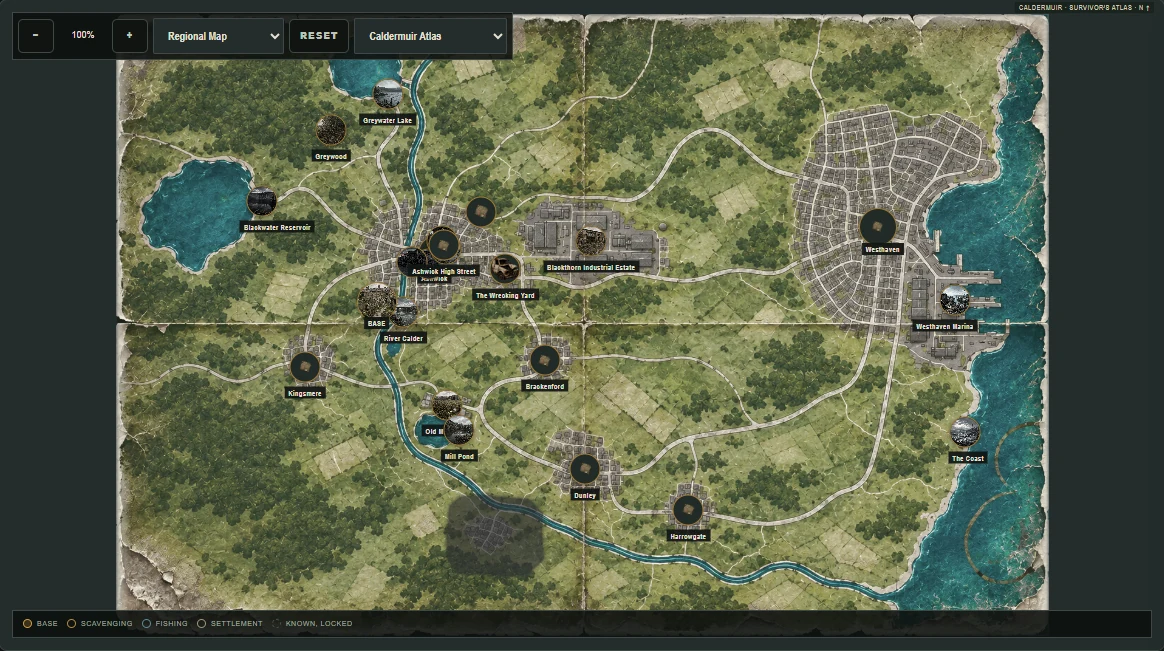
I began with geography rather than decoration. Ashwick needed to remain an inland town. Blackthorn belonged to its east, while Westhaven had to feel like a much more substantial journey towards the coast. Greywood, Greywater Lake, Blackwater Reservoir, Old Mill Farm and Mill Pond all needed to make sense in relation to that wider landscape.
Getting those relationships onto a convincing illustration was less straightforward than putting a pin on a grid. I worked through schematic references, layered illustrations, hand-drawn treatments and continuous-map experiments. Some versions looked attractive in isolation but felt disconnected once settlements, roads and countryside had to share the same screen.
Other versions made the wrong thing prominent: a heavy paper effect, an awkward boundary, or detail that became difficult to read beneath the markers. I kept coming back to the same test. Could I look at the map and understand that these places belonged to one region, rather than a collection of separate pictures?
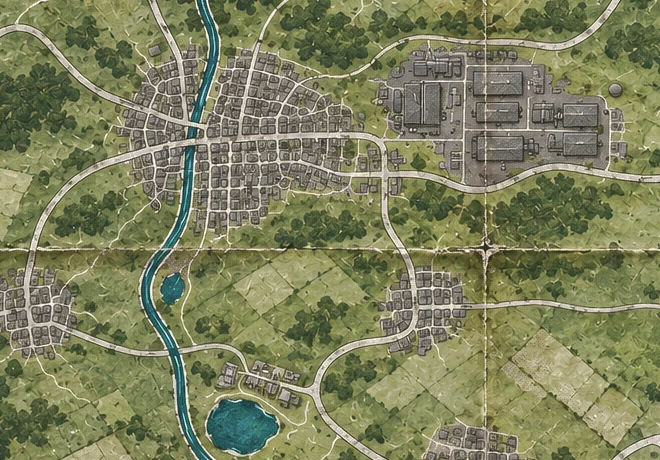
The current Atlas gives that work a continuous foundation. Woodland, fields, waterways, roads and settlement footprints share one illustration. The interactive markers remain part of the game interface, so the map can be readable and useful without baking names or gameplay information into the artwork.
DIFFERENT PLACES, ONE LANDSCAPE
Ashwick is still the starting point: a small inland town surrounded by the countryside a survivor begins to know. Blackthorn has a different shape and purpose, with its industrial roofs and yards. Farther east, Westhaven occupies the coast as the region's much larger urban presence.
I wanted the spaces between them to matter visually. The western Calder valley, northern woodland and lakes, fields around the farm, and the coast beyond Westhaven give familiar destinations context. Mill Pond should feel like part of that countryside, not simply the next Fishing button.
The illustration is a visual way into the established world. It does not rewrite location identities or travel distances. I have also kept the map useful at different scales: zoom in for a closer look, pan around the region, select a location, then reset when you need your bearings again.
THE MAP IS THERE. YOUR KNOWLEDGE ISN'T.
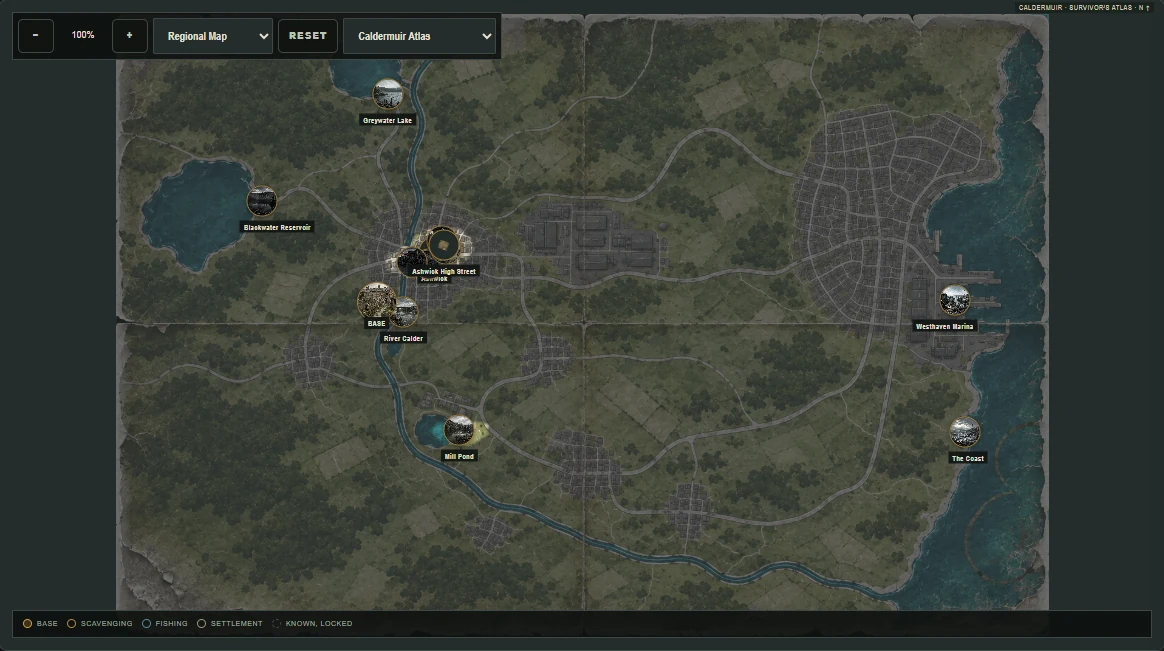
One of the bigger changes came from how I concealed the unknown. Blank parchment had a clear logic, but it could leave the illustrated world looking like disconnected scraps. I wanted the whole document to remain a map, even when a survivor knew very little of it.
Caldermuir now sits beneath a neutral 65% charcoal shroud. Roads, woodland, water and settlement shapes remain faintly visible. Known areas come through in their original colours, with soft, irregular edges where knowledge meets uncertainty.
Seeing a distant shape does not give a survivor its name, activities or interactive marker. Those still follow the existing knowledge rules. A known fishing place does not automatically make the neighbouring city known, and knowing Mill Pond does not quietly grant knowledge of Old Mill Farm.
Each survivor keeps their own understanding of the region. I did not want a new presentation to invent a history of visits that an older save could not prove.
LET THE EVERYDAY WORK LEAVE A TRACE
I also wanted the landscape to develop beyond small islands around location markers. Completed Scavenging searches can modestly expand nearby countryside. Location-specific Foraging evidence and trap-line activity can support small local reveals too. Fishing stays close to its known fishing area.
These are conservative, capped additions, using activity evidence the game already records. They can overlap naturally, but repeated work cannot clear an entire region. Unknown settlement information remains protected.
There is no separate cartography skill, drawing timer or new exploration minigame to manage. The idea is simpler: the ordinary work of surviving should help your personal map feel less empty. Getting this right mattered because I want Going Out There to feel like spending time in a world, not just selecting a different reward table.
SOMEBODY LEFT DIRECTIONS
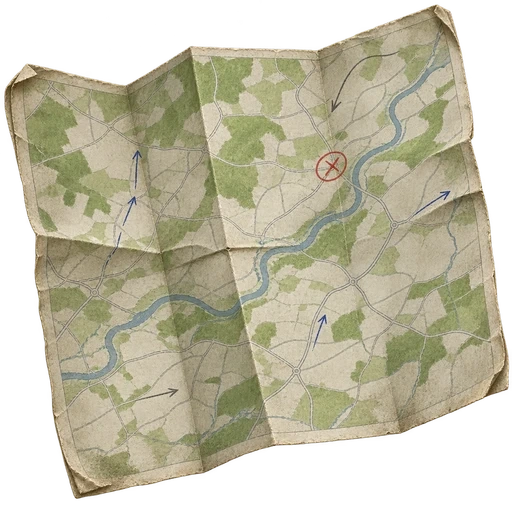
Once the region felt more connected, I wanted a small discovery that could change a survivor's immediate plans. A Survivor Map is a lead to hidden supplies: rough directions somebody kept, marked and, for whatever reason, did not return to use.
Find one through the existing loot system and Study Map to consume a single copy and activate a temporary cache. It works from Backpack or directly from the selected unlocked Storage Home. There is no need to shuffle it into a full Backpack first.
Studying takes you straight to Scavenging and brings the new location into focus. It does not begin searching for you. There is one active lead at a time, so another map stays a future possibility until the current site is finished.
A temporary marker gives the lead a place on the Caldermuir Atlas. It is a survivor-specific supply opportunity, not a new permanent settlement or an automatic discovery of unrelated places.
EIGHT SEARCHES. NO COUNTDOWN.
New leads can point to an Abandoned Survivor Safehouse, a Hidden Medical Cache or a Survivor Supply Stash. Each has its own normal Scavenging tile, description, artwork and weighted supply pool.
A new cache holds eight finite completed searches, with a 60-second base search duration before the existing modifiers. There is no real-world expiry clock. You can prepare, make room or return later; the lead does not disappear because you had something else to do.
Finish the site and it leaves the available activities and temporary map display. The Journal keeps the discovery and exhaustion record. I wanted these finds to be useful little interruptions to a routine, not another limitless resource node.
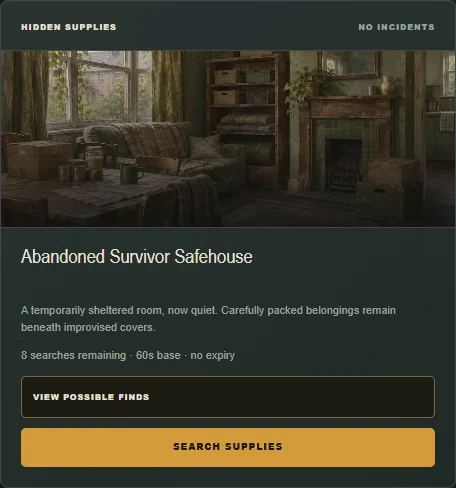
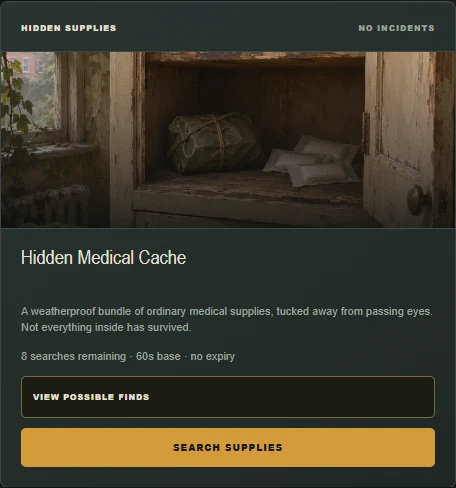
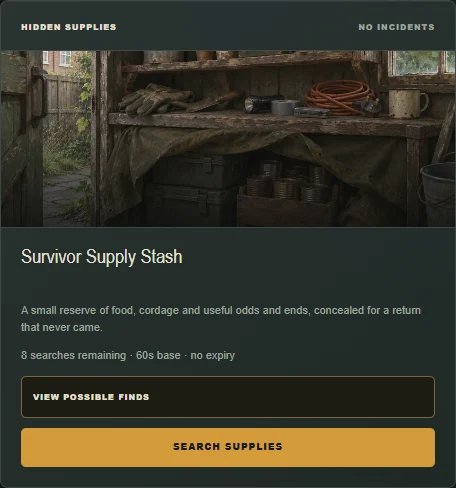
Three possible site types shown for comparison, using separate disposable review survivors. Only one lead can be active per survivor.
PROTECTION AND PRACTICAL THINGS
Most supplies should be useful without having to be spectacular. Food, Field Bandages, medical supplies, cloth, string, batteries and other recovered materials all have a place in these caches. The pools differ so a medical bundle does not feel quite like a room full of somebody's stored provisions.
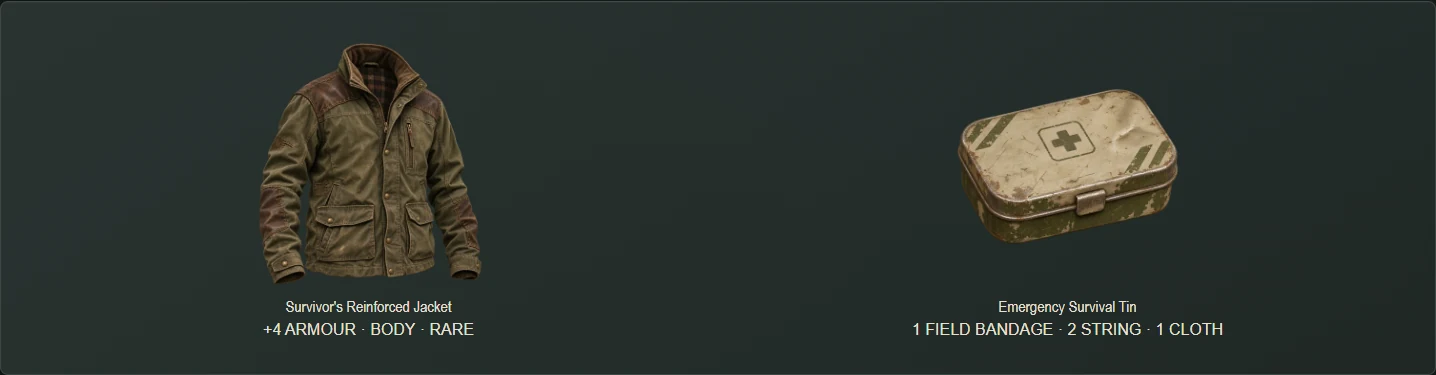
The Survivor's Reinforced Jacket is the new rare equipment find. It occupies the Body slot, gives +4 armour, and is exclusive to Survivor Map supply caches. Its repaired canvas-and-leather appearance is deliberately practical: clothing somebody worked to keep useful, rather than an immaculate piece of apocalypse fashion.
There are other rare possibilities, including useful weapons and equipment, and the valuable Bug-Out Bag. They remain possibilities, not a promise attached to every map. A cache should be worth investigating without turning every discovery into a guaranteed jackpot.
The Emergency Survival Tin is smaller in ambition and sometimes exactly what you need. Opening one gives one Field Bandage, two String and one Cloth. Its contents use the existing inventory system; if the complete contents cannot fit, opening it does not consume the tin or lose part of the reward.
NOT EVERYTHING USEFUL IS LOOT
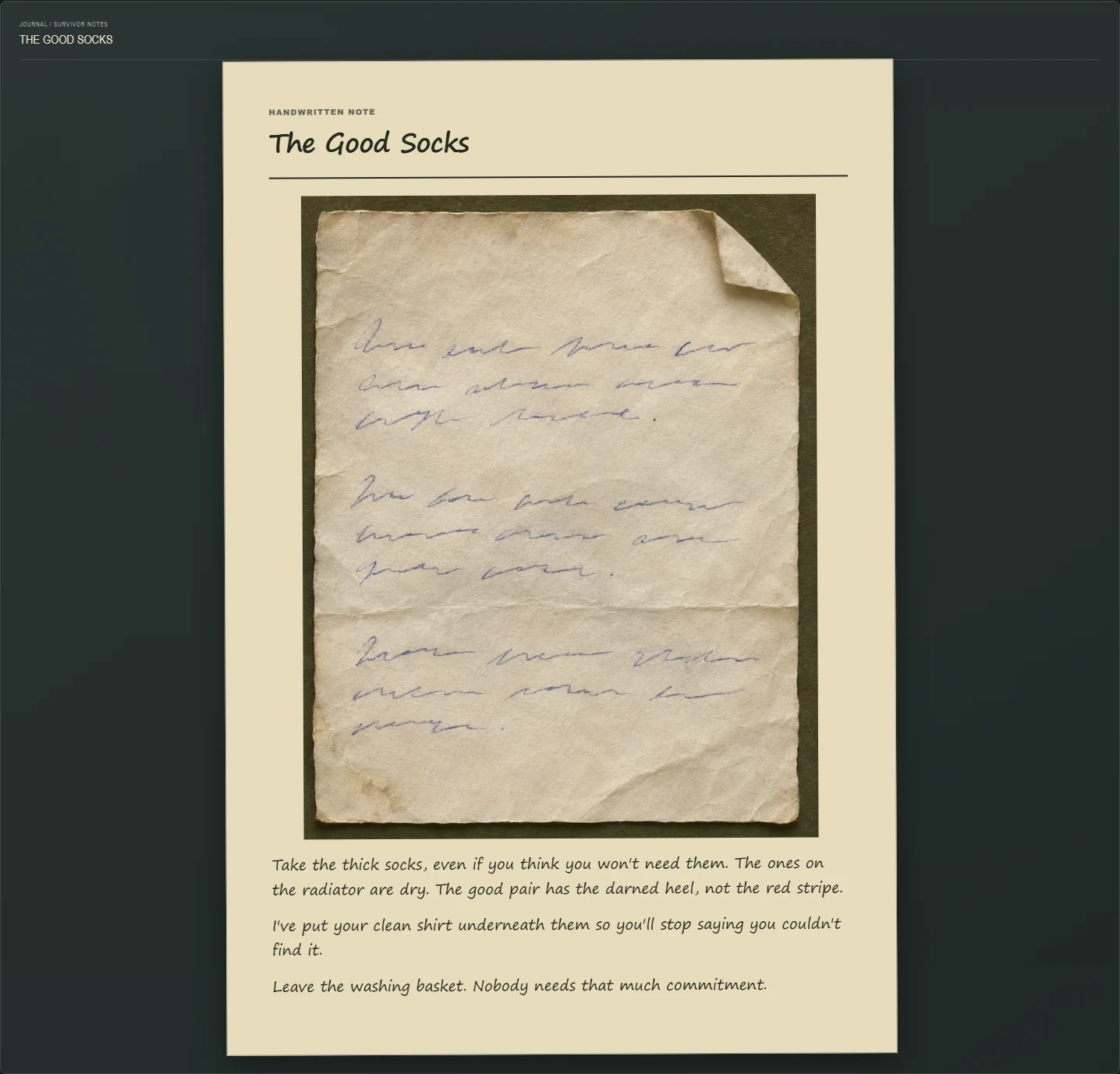
Supplies tell one kind of story. The things people wrote down tell another. I have added fourteen illustrated Journal discoveries: everyday reminders, survivor accounts, supply notes and finds that sit a little less comfortably with you.
I like the ordinary details most. In a world full of damaged buildings and abandoned equipment, a note about something small can make the absence of its writer feel much larger. Not every document needs to unlock a system or announce a grand revelation. Some are there because people still had ordinary concerns when everything around them was becoming extraordinary.
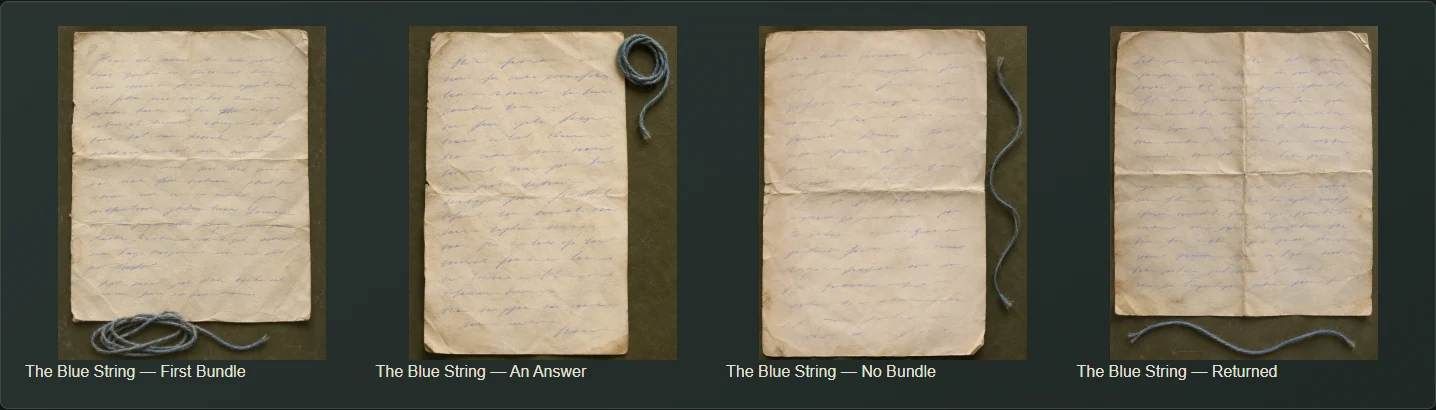
These discoveries have physical presentations appropriate to their contents, rather than fourteen copies of the same placeholder. The artwork sits alongside the separately readable text in the Journal, so looking like a recovered document does not have to mean being difficult to read.
Four entries form The Blue String. Their shared visual identity is a thread to recognise as you find them. I am leaving the rest for the Journal. A development article should introduce the possibility of a story, not deliver its ending before you have found the first page.
MAKE THE REWARD READABLE
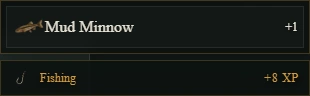
A quiet improvement can make a surprising difference to a repeated action. Item notifications now include the item's name and quantity, while XP feedback identifies the actual Skill and the XP that was awarded.
I repaired the existing feedback path rather than adding another layer of popups. Messages follow committed rewards, respect inventory and loot rules, and combine multiple gains into compact batches. Offline progress remains a summary rather than an avalanche of individual notifications when you return.
This does not add XP to actions that do not award it. Hidden Supplies searches and opening a tin still do not generate XP. The point is to make the game's existing results clearer, including when an ordinary Fishing or Foraging action gives both items and Skill progress.
The direct Study Map navigation belongs to the same effort. A new lead should leave you looking at the place you can search, with enough information to choose your next action. Studying a map should not require a second expedition through the menus.
A REGION TO KNOW. A LEAD TO FOLLOW.
I wanted this milestone to connect three things: a world with a recognisable shape, a survivor whose knowledge of it feels personal, and discoveries that can make the next trip feel slightly different from the last.
Caldermuir gives the destinations a home. Hidden Supplies gives you a small reason to change your plans. The notes left behind are a reminder that somebody else had plans here too.
THE MAP IS NOT FINISHED WITH YOU YET.
The Atlas, Hidden Supplies and these usability improvements are live on Stable now. There is more ahead for 0.6 Survival. For this update, I am happy to let the map, the supplies and the stories do some of the talking.